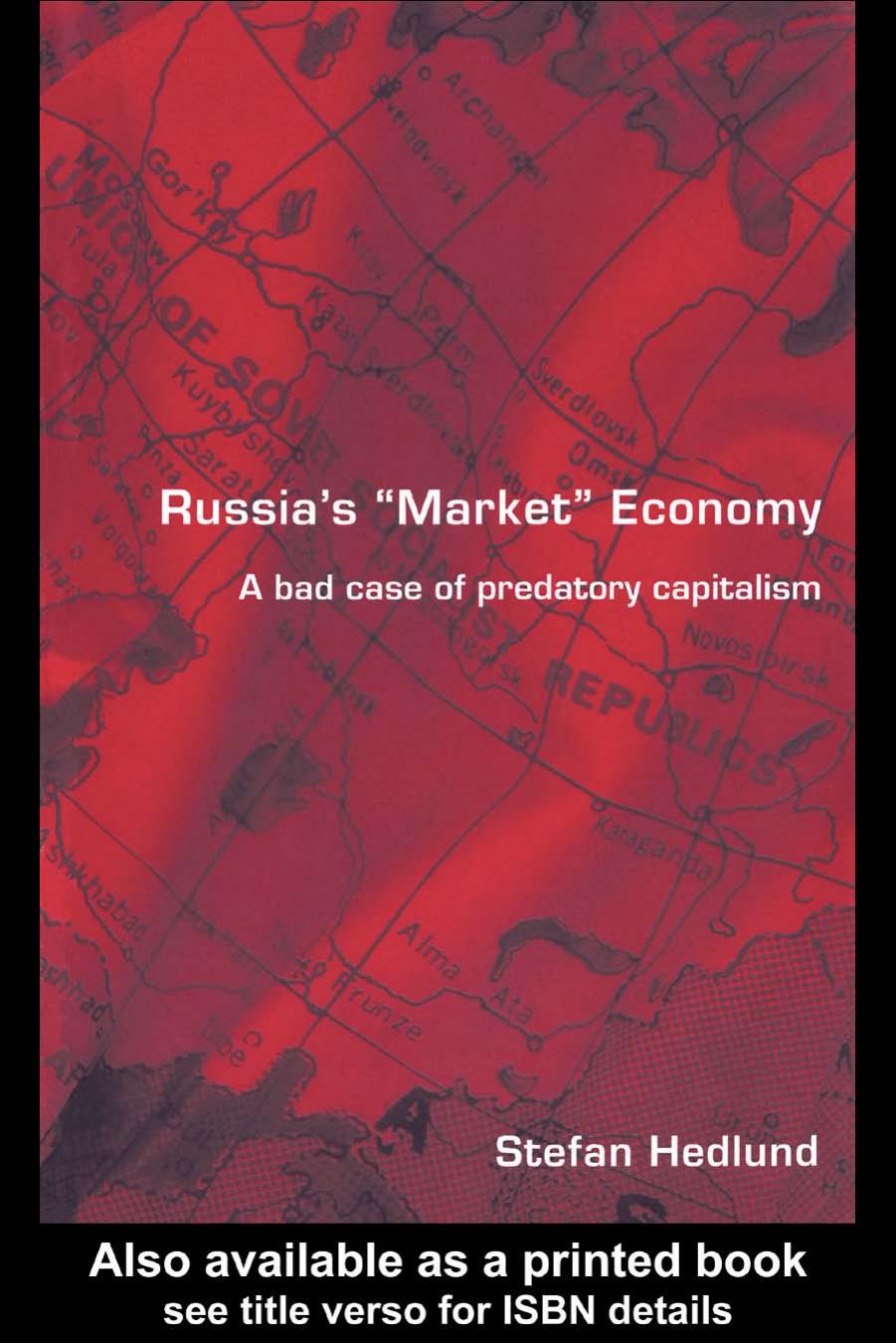
Russia's Market Economy: A Bad Case of Predatory Capitalism by Stefan Hedlund
Author:Stefan Hedlund [Hedlund, Stefan]
Language: eng
Format: epub, pdf
Tags: Political Science, General
ISBN: 9781135433741
Google: MgWOAgAAQBAJ
Publisher: Routledge
Published: 2002-11-01T13:37:24+00:00
Fiscal federalism
While formally a union, in actual practice the Soviet state was unitary and highly centralized. It was only with the âwar of lawsâ of the late 1980s that previously decorative institutional arrangements in the various republics acquired political significance, and then of a mainly centrifugal nature. Republican legislatures began issuing laws and declarations of sovereignty that eventually led to the collapse of the union.
Embarking on its post-Soviet path of building democracy and market economy, Russia had to deal with the fallout of this process. Itself being a nominal federation, the pre-conditions for a repeat performance were in place, and momentum in that direction had been built up as the subjects of the Russian federation were goaded by the Soviet authorities to break off from the Russian centre. Politically as well as economically the Yeltsin administration was thus faced with the task of finding a working federal arrangement.
In theory, there were good prospects for running parallel processes of democratization and federalization. There are plenty of previous examples where federalism has shown itself to be a superior constitutional arrangement. Sutela holds up the positive experience, âHistorically, federalism has proved to be among the most stable and most enduring of polities,â but he also warns that âit does seem to require a political environment conducive to popular government and traditions of political co-operation and self-restraintâ.11
The catch, in the Russian case, is that federalism represents a contractual arrangement and thus hinges for its success upon actors who are willing to prefer rules to confrontation. In what was said in the previous chapter, about the games that were played at the centre, we have seen the very opposite, i.e. weak enforcement and a high level of rule aversion, emerge as defining characteristics.
But this was not the only threat to the prospects for establishing a working system of Russian federalism. The context of the Soviet break-up and of the institutional arrangements that were inherited by the Russian Federation added further fuel to the fire.
In contrast to the Soviet Union, which at the time of its death consisted of 15 republics of formally equal status, the Russian Federation is made up of 89 federation subjects (if Chechnya is included), which are grouped into categories of different status. There are 21 ethnically defined republics (including Chechnya), 55 Russian regions (oblasts and krais), plus 11 autonomous regions (okrugs) located within the krais, and two citiesâ Moscow and St Petersburgââof federal rankâ. The new federation charters that were approved in March 1992 explicitly recognized this rather complicated constitutional arrangement.
In the first couple of years after the Soviet break-up, there emerged in the Russian Federation a clear difference between territorially defined regions and ethnically defined republics. While the former were content with seeking to gain as much economic and legal autonomy as possible, many of the latter had outspoken ambitions of seeking political autonomy or even full independence. The most extreme case was Chechnya, which also provided the most tragic manifestation of the struggle between centre and periphery.
In 1993, these
Download
Russia's Market Economy: A Bad Case of Predatory Capitalism by Stefan Hedlund.pdf
This site does not store any files on its server. We only index and link to content provided by other sites. Please contact the content providers to delete copyright contents if any and email us, we'll remove relevant links or contents immediately.
| Anthropology | Archaeology |
| Philosophy | Politics & Government |
| Social Sciences | Sociology |
| Women's Studies |
The Secret History by Donna Tartt(19088)
The Social Justice Warrior Handbook by Lisa De Pasquale(12190)
Thirteen Reasons Why by Jay Asher(8909)
This Is How You Lose Her by Junot Diaz(6886)
Weapons of Math Destruction by Cathy O'Neil(6279)
Zero to One by Peter Thiel(5801)
Beartown by Fredrik Backman(5754)
The Myth of the Strong Leader by Archie Brown(5507)
The Fire Next Time by James Baldwin(5444)
How Democracies Die by Steven Levitsky & Daniel Ziblatt(5218)
Promise Me, Dad by Joe Biden(5153)
Stone's Rules by Roger Stone(5087)
A Higher Loyalty: Truth, Lies, and Leadership by James Comey(4963)
100 Deadly Skills by Clint Emerson(4925)
Rise and Kill First by Ronen Bergman(4788)
Secrecy World by Jake Bernstein(4753)
The David Icke Guide to the Global Conspiracy (and how to end it) by David Icke(4718)
The Farm by Tom Rob Smith(4509)
The Doomsday Machine by Daniel Ellsberg(4490)
